Corporate Laws (Amendment) Bill, 2026 — what it means for your company, and how to prepare
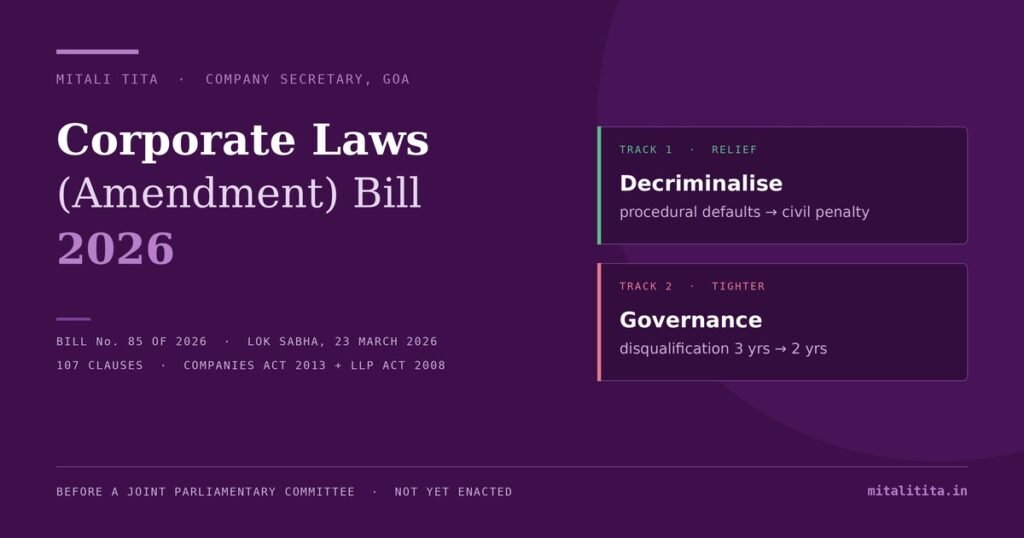
Home›Blogs›Corporate Laws (Amendment) Bill, 2026 Companies Act · Proposed legislation Corporate Laws (Amendment) Bill, 2026 — what it means for your company, and how to prepare Imagine telling a client that from next year they probably will not collect MBP-1 forms from every director each April, that board meetings could drop to one a year, that the AGM could be held over video permanently, and that a late filing would bring a penalty notice rather than a criminal summons. That is the world this Bill is designing. It is not there yet. Mitali Tita · Practising Company Secretary Updated 29 July 2026 18 min read Status — this is a Bill, not law The Corporate Laws (Amendment) Bill, 2026 (Bill No. 85 of 2026) was introduced in the Lok Sabha on 23 March 2026 and referred the same day to a 31-member Joint Parliamentary Committee. The JPC took submissions from the Ministry of Finance and the National Financial Reporting Authority on 24 June 2026, and its report is expected by the Monsoon Session. Nothing in this article is in force. Individual clauses may be altered, dropped or added before enactment, and once enacted, different provisions will be brought into effect on different dates notified by the Central Government. Apply current law. Prepare for what is proposed. The short version 107 clauses, amending both the Companies Act 2013 and the LLP Act 2008 — built on the Company Law Committee report and the 2025 High-Level Committee on Non-Financial Regulatory Reforms. Two tracks at once. Procedural defaults move from criminal offence to civil penalty. Governance failures get tighter consequences. Reading only the relief half is the mistake to avoid. Small company limits proposed to double again — paid-up capital ₹10 crore to ₹20 crore, turnover ₹100 crore to ₹200 crore, on top of the increase already notified in December 2025. Director disqualification gets stricter, not looser — the non-filing trigger drops from three consecutive years to two. Do not wait for relief. Decriminalisation is prospective. A default that exists today stays a criminal offence today, and compounding under Section 441 remains the route to clear it. The idea behind the Bill: two-track enforcement Unlike the 2025 changes, which were operational — new portal formats, new form fields, enhanced Board Report disclosures — this Bill is about how compliance is designed in the first place. It draws a deliberate line between two kinds of non-compliance. Procedural mistakes — late filings, missed documentation, technical lapses where nobody was harmed and no fraud occurred — should carry civil financial penalties determined by an adjudicating officer, not the shadow of criminal prosecution. Governance failures — fraud, related-party abuse, audit manipulation, director self-dealing — should carry tougher consequences than they do now. Both directions are in the same Bill, and the second one is easy to miss in the coverage. Track 1 — decriminalise the procedural Defaults that presently carry imprisonment risk move into a civil penalty framework. An adjudicating officer determines the penalty rather than a court. The company pays and moves on — no prosecution, and no personal criminal record for directors or the company secretary. The decriminalised list includes contravention of Rules, failure to furnish information or documents required by the Registrar, violations of the books-of-account requirements, and failure to comply with a Registrar’s requisition. Track 2 — tighten the governance Independent director eligibility is tightened. Director disqualification for non-filing triggers after two years rather than three, with a new ground added for related-party transaction penalties. NFRA gains corporate status and enforcement powers. Auditors face registration and reporting obligations. Governance failures get fewer second chances than they do today. The practical implication is a change of posture. Small procedural defaults should become cheaper and faster to resolve once the Bill is in force. Governance defaults — a missed related-party approval, a compromised independent director qualification, an audit quality failure — will meet stronger institutional consequences than they do now. Do not wait for decriminalisation The conversion of criminal defaults to civil penalties applies prospectively, from the date each provision is notified. Defaults that exist today remain criminal offences today. A company with outstanding annual return non-filings, unresolved charge registration delays or pending director KYC gaps should regularise now, through compounding under Section 441 — not sit and wait for the Bill to deliver automatic relief that it does not offer. Which changes hit which kind of company The proposals do not affect every company equally. A listed company with fifty thousand shareholders cares about virtual AGMs. An OPC cares about board meeting frequency. A GIFT IFSC company cares about foreign currency capital. This maps the Bill to entity type. Impact by entity type Entity type What applies What does not Action now One Person Company Board meetings reduced from two a year to one. Small company threshold rise, where the OPC qualifies. Decriminalisation of filing defaults. MBP-1 only on change. Virtual AGM provisions — an OPC does not hold an AGM in the conventional sense. NFRA provisions. Review the Articles to confirm the board meeting provisions are consistent. Older Articles specifying a quorum of two sit badly with a sole-director OPC. Newly qualifying small company₹10–20 cr capital or ₹100–200 cr turnover Qualifies as small under the proposed ₹20 cr / ₹200 cr limits. Four board meetings drop to one. MGT-7A instead of MGT-7. Cash flow statement exemption. Rule 9B demat exemption potentially restored. MBP-1 only on change. DIN KYC every three years. SBO compliance under Section 90 continues regardless of small company status. Director disqualification rules still apply in full. This is the group that gains most. Identify every client in the band now, so the compliance calendar can be switched the moment the provision is notified. Growing private companyabove the small company limits Permanent virtual AGM, with one physical meeting every three years. MBP-1 only on change. DIN KYC every three years. Charge registration window extended to 180 days for prescribed classes. Two buy-backs a year for prescribed classes. RSU and SAR
Companies Act 2013: key amendments in 2025 — what every company must know now
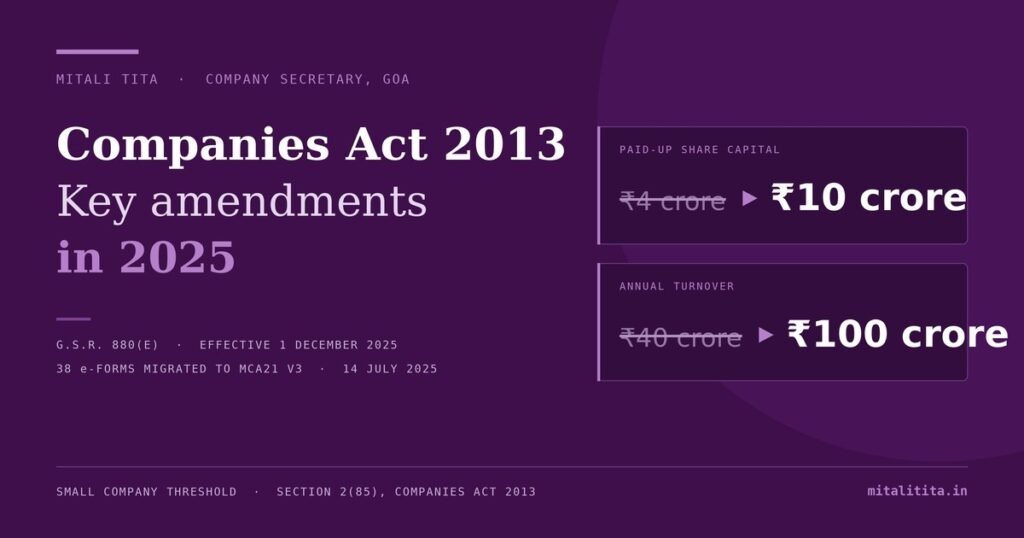
Home›Blogs›Companies Act 2013 amendments 2025 Companies Act · Compliance update Companies Act 2013: key amendments in 2025 — what every company must know now 2025 was the most active year for Companies Act compliance changes in a decade. The small company threshold more than doubled, thirty-eight statutory e-forms moved to the MCA21 V3 portal and the V2 portal closed for good, and the Board Report gained two new mandatory workplace-compliance disclosures. This is what changed, what the notification says, and what has to be done differently as a result. Mitali Tita · Practising Company Secretary Updated 29 July 2026 16 min read The short version Small company thresholds more than doubled. From 1 December 2025, paid-up capital up to ₹10 crore and turnover up to ₹100 crore — up from ₹4 crore and ₹40 crore. Notified by G.S.R. 880(E). The V2 portal is gone. It was disabled on 18 June 2025 and the final set of 38 e-forms went live on V3 on 14 July 2025. Every annual filing is now web-based, requires a Class 3 DSC, and must follow a fixed sequence. The Board Report has two new mandatory disclosures — POSH complaint data and a Maternity Benefit Act compliance statement — under the Companies (Accounts) Second Amendment Rules, 2025. AOC-4 and MGT-7 now ask for data most companies do not hold — absolute rupee figures, the ADT-1 SRN, registered-office geo-coordinates, gender-wise shareholder data and employee headcount by gender. One open question remains. Which threshold applies to a financial year that closed before 1 December 2025 has not been formally clarified. See the caution below before you rely on the new limits for an earlier year. The Ministry of Corporate Affairs issued a run of significant amendments through 2025 — a long-awaited increase in the small company financial thresholds, the compulsory migration of thirty-eight statutory e-forms from the legacy V2 portal to MCA21 V3, and enhanced mandatory disclosures in the Board Report covering workplace compliance. Each of these changes affects how annual compliance calendars are structured, how filing teams prepare submissions, and what a Company Secretary has to check before a form can even be started. For private limited companies the most immediately useful change is the revised small company definition. Thousands of growth-stage startups and MSMEs that had crossed the earlier limits, and had therefore moved onto the fuller compliance regime, can now potentially re-qualify as small companies and return to the lighter track. The consequences run through mandatory dematerialisation, the number of board meetings required, auditor rotation, and which annual return form is filed. This guide covers every significant amendment from 2025 — what changed, the notification reference, when it took effect, and the practical action it creates. A full reference table and a before-and-after filing calendar sit further down. Amendment 1 — small company threshold more than doubled The single most consequential change of 2025 for private limited companies is the enhanced small company threshold, notified through G.S.R. 880(E) dated 1 December 2025 — the Companies (Specification of Definition Details) Amendment Rules, 2025, which substituted clause (t) of Rule 2(1) of the 2014 Rules. The amendment took effect from the date of publication in the Official Gazette. A company now qualifies as a small company under Section 2(85) if it satisfies both conditions at once: Paid-up share capital not exceeding ₹10 crore, up from ₹4 crore Turnover, as per the most recent audited profit and loss account, not exceeding ₹100 crore, up from ₹40 crore The conjunctive test is unchanged. A company with ₹8 crore of paid-up capital but ₹120 crore of turnover is not a small company — it fails on turnover, and the capital position is irrelevant. How the threshold has moved ₹50 lakh / ₹2 crore under the Companies Act 2013 as enacted → ₹2 crore / ₹20 crore by G.S.R. 92(E) dated 1 February 2021 → ₹4 crore / ₹40 crore by G.S.R. 700(E) dated 15 September 2022 → ₹10 crore / ₹100 crore by G.S.R. 880(E) dated 1 December 2025. Every revision has more than doubled the previous limits. Who is excluded even when the thresholds are met Meeting the financial tests is not sufficient. The following can never be small companies: Holding companies — a company that is the holding company of any other company is excluded regardless of its own size Subsidiary companies — a subsidiary of any other company is excluded Section 8 companies — companies formed for charitable or not-for-profit objects Public companies, and banking, insurance and other specified entities excluded by the Act itself What small company status is actually worth The value of the classification lies in the relaxations attached to it. A company newly qualifying under the raised thresholds can access: Board meetings — a minimum of two per financial year instead of four, with the gap between them not exceeding ninety days Annual return — MGT-7A, the abridged form for small companies and OPCs, instead of the full MGT-7 Cash flow statement — not required as part of the financial statements Auditor rotation — the rotation requirement under Section 139 does not apply Mandatory dematerialisation under Rule 9B — small companies are outside the demat requirement that applies to other private companies, so a company that re-qualifies may fall back out of scope Reduced internal financial control reporting for directors Secretarial audit under Section 204 is a separate test entirely — it applies to listed companies and to public companies above prescribed capital or turnover thresholds, so a private small company was never within it. Open point — which year’s threshold applies The amendment took effect on 1 December 2025, mid-way through a financial year. Small company status is assessed on the figures of the immediately preceding financial year — and for FY 2024-25, that year closed on 31 March 2025, when the old ₹4 crore / ₹40 crore limits were in force. Whether a company that clears the new limits but not the old ones could claim small company status for
Hello world!
Welcome to WordPress. This is your first post. Edit or delete it, then start writing!